AI Is Already Inside Your Company — Even If You Never Invited It In: The BYOAI Phenomenon
68% of skilled employees already use artificial intelligence at work, but 77% do so with their own tools and no oversight. Meanwhile, only 22% of organisations have restructured their teams to integrate it. Our thoughts on the silent gap between workforces and their companies — an analysis covered by El Economista and RRHH Digital.

Madrid. September has a bad reputation, and deservedly so. Going back to work after the holidays triggers post-holiday syndrome, which already affects one in three workers according to Hospital Clínic de Barcelona and Adecco España — anxiety, trouble sleeping, irritability, difficulty concentrating. And there's an aggravating factor we talk about less: returning to an overflowing inbox and to repetitive processes that technology has been promising to take off our hands for years.
The striking thing is that the technology is already in the office. It just came in through the back door.
BYOAI: the adoption companies don't see
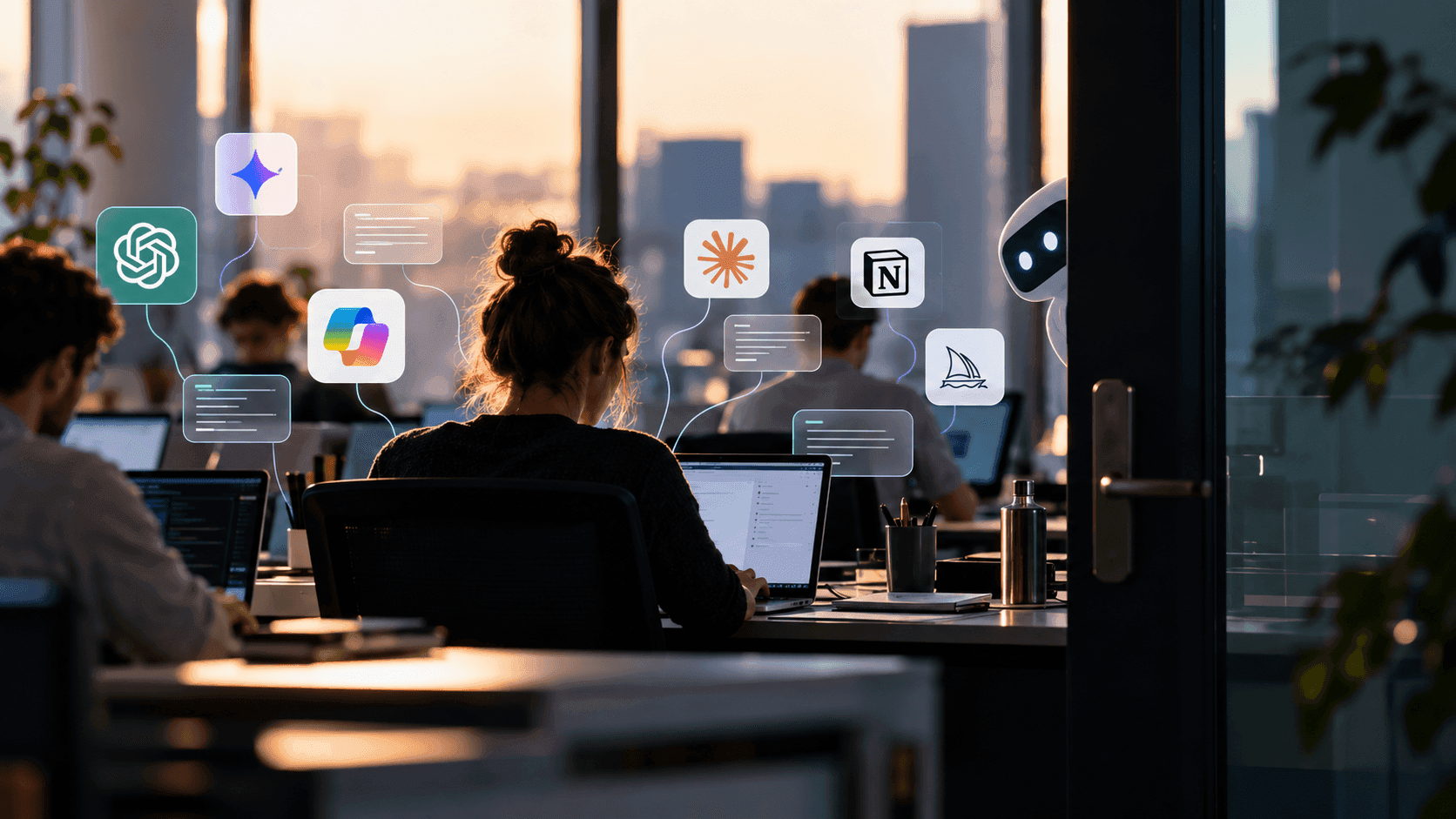
The data draws an uncomfortable gap. 68% of skilled workers already use AI tools, but in the absence of a clear strategy from their organisations, 77% have chosen to bring their own to the workplace, according to Microsoft. The phenomenon has a name — BYOAI (Bring Your Own AI) — and a blunt reading: employees are adopting AI faster than their own companies.
Corporate adoption figures confirm it. Only 21% of Spanish companies with 10 or more employees were using AI in early 2025 according to INE (a nine-point jump in a year, granted), and while 58% of large corporations have already integrated it according to Eurostat, the key figure is a different one — only 22% of organisations have restructured their teams to integrate it strategically, according to IDC. Four out of five operate exactly as they did before ChatGPT existed. We reflected on this gap in an analysis covered by El Economista in its print edition, RRHH Digital and Revista Byte
Why BYOAI should keep you up at night (a little)
Teams using AI on their own proves something good — there's appetite, there's curiosity, and there's productivity waiting to be captured. But doing it without a framework has a cost. Corporate data flowing through personal tools with no oversight, results with no traceability, decisions leaning on models nobody has validated, and growing regulatory exposure with the AI Act already in force. It's the 2026 version of shadow IT, with one important difference: what leaks here isn't just licences — it's knowledge and judgement.
The answer isn't to ban it — that only drives the phenomenon underground. It's to structure it. As Francisco Moreno Balboa, our CEO and founder, puts it, "trust in such a transformative technology is only earned when the company feels it remains in control". That's why we insist AI should always be deployed under a clear framework of data governance, cybersecurity, traceability and human oversight.
September, the best time to put the house in order
There's a window of opportunity in the calendar. "Going back to work after the summer holidays can be the perfect moment to implement new processes that genuinely free up the teams' time, building a more productive dynamic. That's how companies stop operating as mere firefighting squads and start building a solid strategy to move forward," Francisco notes.
In our experience, moving from interest to real implementation requires end-to-end support — identifying the opportunities, integrating the technology with existing systems and, above all, achieving adoption by the teams. AI accelerators (pre-configured solutions by industry, quick to deploy) and platforms like ADA exist precisely to shorten that path: we ourselves have doubled the number of projects delivered in the last year without doubling the team. That's exactly the promise.
The question is no longer whether your workforce will use AI — it already does. The question is whether it will do so with the control, security and strategy your company needs. If you want to bring order to that scenario before inertia does it for you, let's talk.
Key takeaways
The phenomenon of employees bringing their own AI tools to work in the absence of a company strategy — according to Microsoft, 77% of skilled workers who use AI do so this way.
21% of those with 10 or more employees (INE, early 2025) and 58% of those with over 250 employees (Eurostat). But only 22% have restructured their teams to integrate it strategically (IDC).
Corporate data leaking through personal tools, lack of traceability, decisions based on unvalidated models and regulatory exposure under rules such as the AI Act.
With a framework of data governance, cybersecurity, traceability and human oversight, and end-to-end support — from identifying opportunities to team adoption.