The AI Act isn’t here to slow down your AI, it’s here to punish improvisation
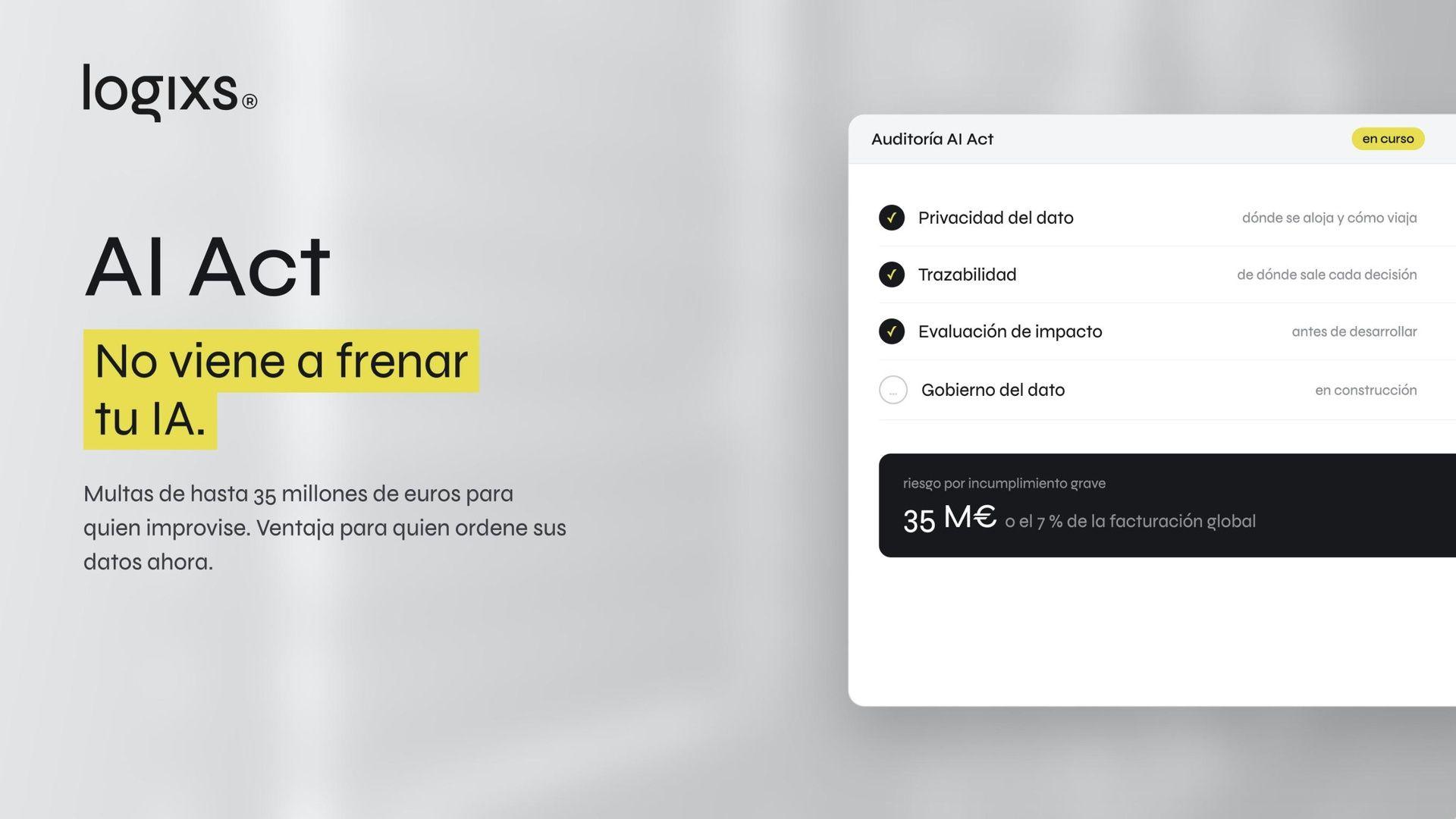
Fines of up to 35 million euros for those who improvise. A competitive edge for those who get their data in order now. This is what the European AI regulation really demands of large Spanish companies.
Madrid. The AI Act has been in force since August and the same question keeps coming up in boardrooms. Should the AI projects already under way be put on hold?
The short answer is no. The law does not punish ambition, it punishes improvisation.
The debate arrives at a noisy moment. Several voices in the sector are calling for a pause in AI development, and confusion about the European regulation feeds doubts in thousands of companies. We analysed it in an article picked up by more than 15 outlets, including El Confidencial Digital, Diario Siglo XXI, Navarra Información and Crónica Económica, and which Francisco Moreno Balboa expanded on in his Kapital Empresa interview.
What the AI Act demands
The AI Act is the European regulation that governs artificial intelligence systems according to their level of risk. Penalties reach 35 million euros or 7% of global turnover for the most serious breaches. Sensitive sectors such as banking, energy and healthcare have the most to gain from a well-protected deployment.
For large companies, the requirements come down to two fronts.
Data privacy. You need to know which data can be fed to AI tools and which is sensitive. Also where it is hosted, how it travels, how it is protected and what happens if it leaks. That information has to be known from the start, from the architecture itself.
Traceability. Your company needs to be able to reconstruct where any decision or statement from an AI system comes from. Without that you cannot measure its impact or act when something fails. It is the word heard most across the sector, and with good reason.
Planning is not braking
“Far from paralysing potential AI projects, this regulation encourages companies to enter a deeper and more interesting planning phase,” explains Francisco Moreno Balboa, CEO and founder of Logixs. “The aim is not to slow down innovation but to make it more accessible, always keeping governance in mind for its implementation.”
His recommendation is concrete. Use the regulation to review the foundations of the AI projects already under way and make sure they comply with the rules in force since August, and with those still to come.
Three moves for the coming months
- Review the foundations. Audit your AI projects in progress and check they can answer the regulation’s two questions. Where is the data and where does each decision come from.
- Put a team on planning. Someone has to assess each system’s impact before building it and minimise risks. The result is a better product, not a slower project.
- Build data governance. “Those who use the coming months to build solid data governance will reach the market with an enormous competitive advantage,” Francisco sums up.
Complying without braking is a knowledge problem
The traceability the AI Act demands is the same we require of any system before putting it into production. That is why we built ADA. ADA brings together everything a company knows, what lives in its systems and what only its people carry, into one brain that AI uses to work. By relying on what the company truly knows, AI stops hallucinating, costs less and every answer can be traced back to its source and audited.
If you want to review your AI’s foundations before an auditor does, let’s talk.
Key takeaways
No. The regulation demands planning, data privacy and traceability. Companies with solid data governance can keep innovating with an edge over those who improvise.
Up to 35 million euros or 7% of global turnover for the most serious breaches.
Two things above all. Knowing what data its AI uses, where it is hosted and how it is protected, and being able to reconstruct where every decision comes from.
By grounding AI in the company’s structured knowledge, so every answer can be traced back to its source and audited, as ADA does.