AI-Powered Recruiting: More Speed, Same Human Judgement
More than half of organisations already use artificial intelligence in their hiring processes, but the future of recruitment isn't about automating the decision — it's about combining technology and human judgement. Our take on a topic El Mundo recently covered in a feature we contributed our perspective to.

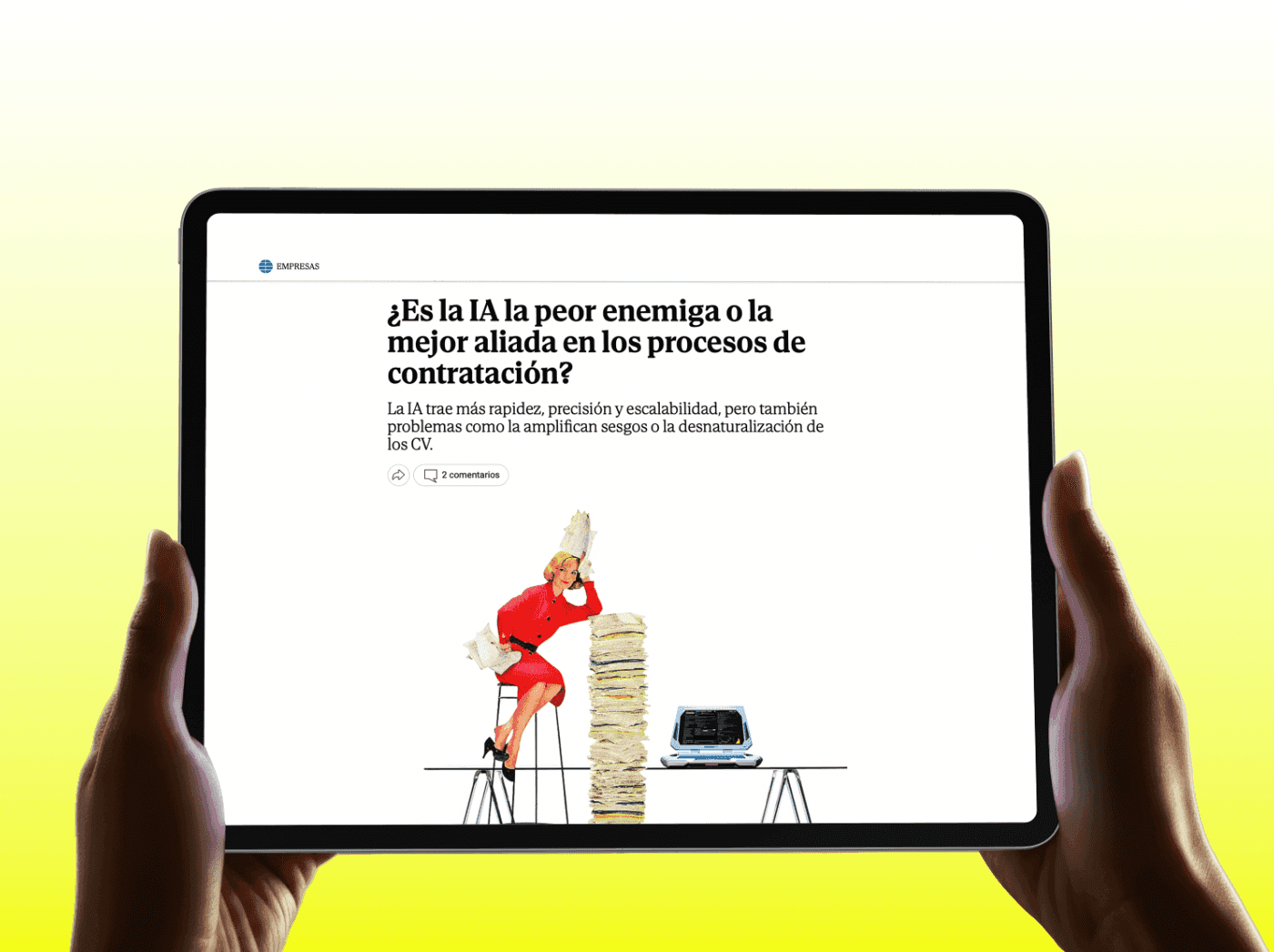
Madrid. There's a mistaken image that haunts artificial intelligence in human resources — that of a machine deciding who gets in and who doesn't. In our experience, reality runs a different course. AI applied to recruitment works best as a layer of intelligence that organises information, detects fit and personalises assessments, always leaving the final decision in the hands of the human team. El Mundo recently reflected on this moment of transition in a feature on AI at the service of human resources (in Spanish), in which we had the chance to contribute our perspective.
Where we really are
AI is no longer a futuristic promise in hiring processes. In 2025, more than half of organisations already reported using it in recruiting, mainly to save time and gain efficiency — writing job posts, initial candidate screening, profile sourcing, interview scheduling. And it arrives amid strong pressure on the labour market, where certain capabilities are harder to find and it matters more and more to detect not just prior experience, but learning potential. The World Economic Forum itself points out that many of the skills required today will change by 2030, and that companies will need to combine technological skills with deeply human ones such as collaboration, resilience and analytical thinking.
The main challenge isn't technological — it's human
Adopting AI without losing closeness or judgement. That, for us, is the real challenge. In a hiring process, people need to feel accompanied and well treated, and AI can bring efficiency — but always with human oversight, and without compromising transparency, fairness or the candidate experience. The risks are real: amplifying biases already present in the data, making automated decisions harder to explain, or raising doubts about the use of personal information.
It happens on the candidate's side too. AI has made writing a CV faster, and that can help get past the first screening — but a CV beautifully crafted with AI doesn't always reflect a person's real value. It opens the initial door; after that, the recruitment team's judgement takes over.
Applied well, it doesn't just accelerate — it professionalises
The value of technology isn't just in automating tasks or moving faster, but in making the process better designed from the start. It helps define more clearly which competencies each role requires, unify criteria across interviewers, compare applications consistently and reduce improvisation. It also helps you understand where your own process fails — spotting bottlenecks, seeing at which stages candidates drop off, measuring response times. Applied well, technology makes recruitment more coherent, more useful and more solid, for both the company and the candidate.
There's one more benefit we find especially interesting: anticipation. AI makes it possible to forecast talent needs, detect turnover patterns and identify which profiles will be hardest to fill — moving from reactive recruiting to strategic talent management.
We've seen it work
The real value shows in real cases. We've used AI to match highly specific profiles from CVs — for example, finding a lawyer with international experience in maritime law and knowledge of both Spanish and Canadian legislation. It's in that kind of vacancy, with very precise requirements, where well-applied AI stops being a trend and becomes a tool that makes processes more accurate and effective.
In the long run, AI will stop being seen as an add-on and become a natural part of hiring, just as nobody today questions using software to manage applications. The companies that perform best will be those that know how to combine technology with judgement, employer branding and a well-cared-for candidate experience. If you're thinking about how to apply this in your organisation, let's talk.
Key takeaways
It shouldn't. Its role is to organise information, detect fit and personalise assessments; the final decision must always remain with the human team, with transparency and oversight.
Amplifying biases present in the data, making automated decisions harder to explain and raising doubts about the use of personal information. That's why it demands vigilance over bias, privacy and human oversight.
Writing job posts, initial screening, profile sourcing, interview scheduling, process analytics and matching highly specific profiles — in 2025, more than half of organisations were already using it.