The Summer Spanish Tourism Met AI: Three Changes Already Underway
Tourism is nearing 12.9% of GDP and breaking records, yet every high season leaves the same picture — overwhelmed teams, unanswered calls and systems that don't talk to each other. Our thoughts on how artificial intelligence is starting to fix that bottleneck, an analysis covered by outlets such as Portal ERP.
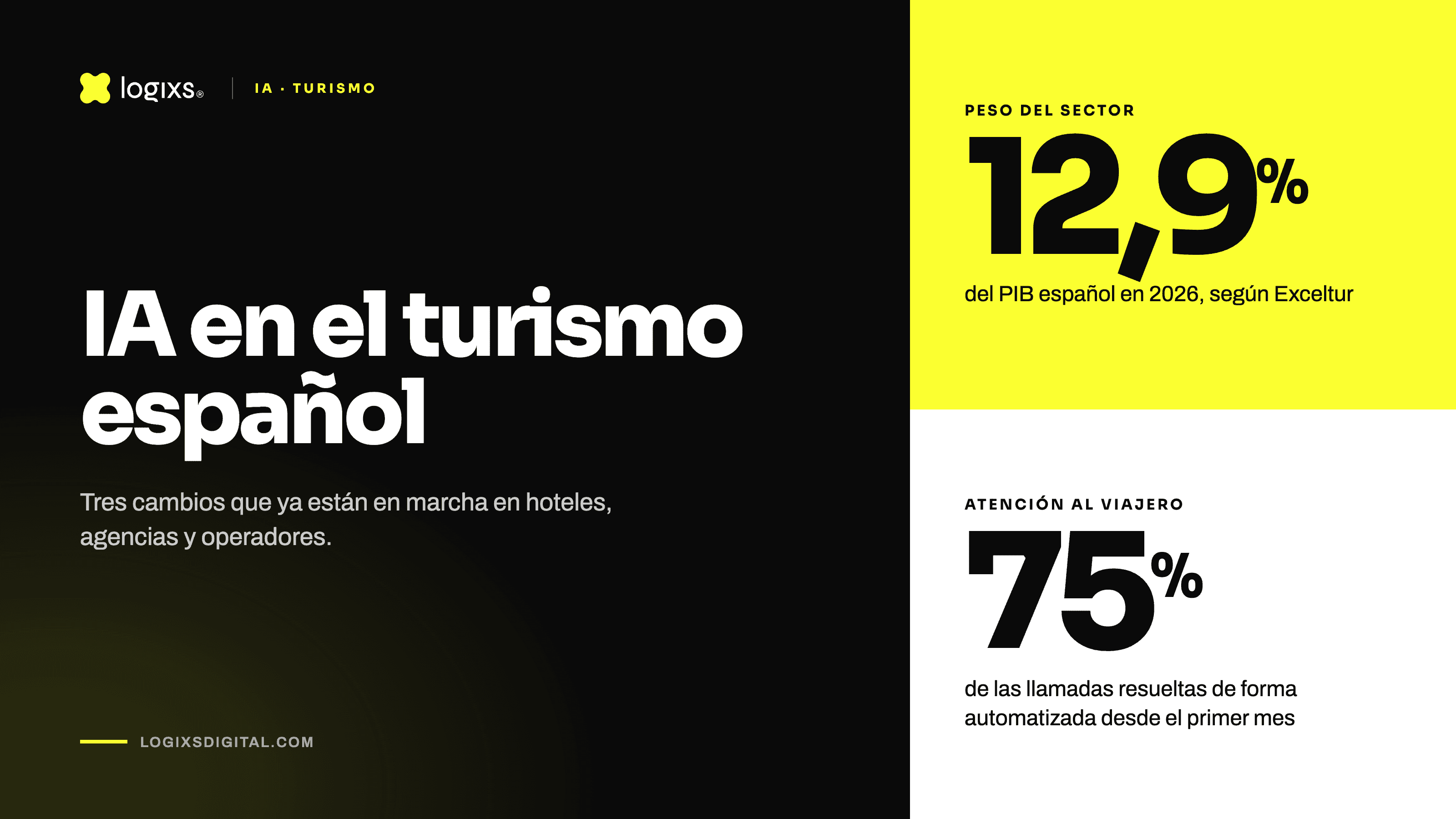
Madrid. There's a paradox at the best moment in the history of Spanish tourism. Exceltur has raised its growth forecast for 2026 to 2.7% and now puts the sector's weight at 12.9% of GDP — and yet, every high season the same scene repeats itself. Soaring volumes of enquiries, bookings and changes, overwhelmed teams, limited opening hours, language barriers and systems that don't communicate well with each other. Every traveller knows the result: waiting, frustration and experiences that don't live up to the destination.
Add to that pressure the competition from the big platforms and the shortage of qualified staff. Technological transformation is no longer optional for hotels, agencies and operators — and that's where artificial intelligence is starting to play a role that goes far beyond the run-of-the-mill chatbot. We recently analysed it in a piece covered by outlets such as Portal ERP and Murcia.com (in Spanish), and we can sum it up in three keys.
1. Traveller service moves to the phone and WhatsApp — with an AI agent on the line
When travellers have an issue, they want it solved now, and their favourite channels are the phone and WhatsApp. The problem comes at demand peaks, when the answer is slow or simply never arrives. Conversational AI agents have changed that scenario — they hold natural conversations, can be interrupted without losing the thread, understand accents and nuances, and complete end-to-end tasks integrated in real time with the hotel's booking systems, CRM or PMS.
This isn't theory. With Carolina, our conversational agentic technology, we've seen that 75% of calls are resolved automatically from the very first month, with 24/7 service 365 days a year. Cost per interaction drops dramatically without any dip in the quality perceived by the customer.
2. From static catalogues to real-time hyper-personalisation
Today's travellers look for authentic, distinctive experiences, yet much of the industry still runs on static catalogues and manual processes. AI makes it possible to cross-reference a customer's preferences and history with the trip's context and real-time availability, recommending destinations, activities and upgrades — on the same budget. An agency can deploy an agent that finds flights, hotel and activities in a single conversation and sends the complete itinerary before the booking is even closed. The upshot is twofold: more enquiries converted into bookings and a higher average ticket thanks to contextual upselling.
3. The invisible operations, finally connected
Booking changes, cancellations, sending documentation, authorisations — administrative work devours hours in hotels, agencies, transport and rental companies. It's exactly the kind of task AI handles best, maintaining traceability and connecting systems that traditionally never spoke to each other. We've experienced it with ADA when digitalising end-to-end processes, from the web request to the automatic issuing of authorisations in PDF — response times dropping from days to minutes, with real-time visibility through automated dashboards.
High season shouldn't overwhelm anyone anymore
The combination of conversational agents, personalisation and connected systems will mark the difference between the tourism companies that scale their service and those still firefighting every summer. The technology exists, it's proven, and it integrates with what you already have. If your hotel, agency or operator wants to face the next high season with a different outlook, let's talk.
Key takeaways
On three main fronts: conversational agents handling phone and WhatsApp enquiries integrated with bookings, CRM and PMS; real-time hyper-personalisation of offers; and automation of booking and operations admin.
Yes. Today's conversational agents hold natural conversations, handle interruptions, understand accents and complete end-to-end tasks — in the case of Carolina (Logixs), 75% of calls are resolved automatically from the first month, 24/7.
According to Exceltur, it will reach 12.9% of GDP in 2026, after the sector's growth forecast was revised up to 2.7%.