

López de Hoyos Street 64, 1G. 28002 Madrid, Spain
Advanced Conversational Data Analysis Platform
Sumiriko
Generative AI, Multi-Agent Architecture, Data Analysis & RAG
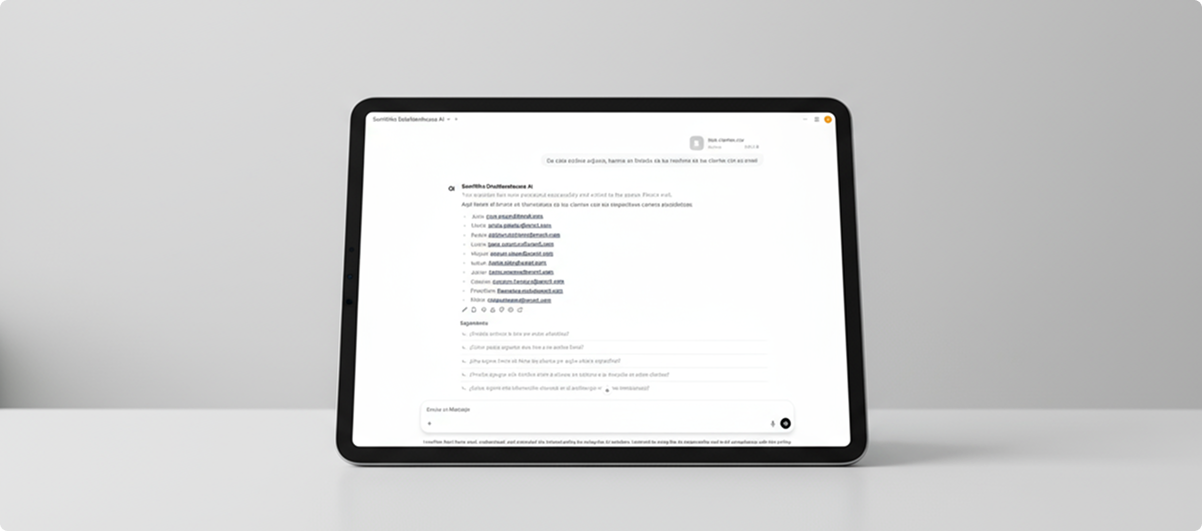
We designed a solution that transforms how organizations query and exploit their critical business information. Through a generative AI model, we developed a conversational platform that allows any user to obtain complex insights through natural language, eliminating technical barriers and significantly reducing response times. Our specialized multi-agent approach not only answers questions about SQL databases, but integrates capabilities for generating graphs, document analysis and file processing (CSV, Excel, PDF). All of this deployed in an On-Premise environment that ensures data confidentiality, with hybrid architecture prepared to scale to the cloud as needed, always maintaining total control over sensitive information.
Challenges
- Specialized multi-agent architecture: Design of a system router (Planner) that directs queries to specialized assistants (SQL, Graphics, Documental Analysis), optimizing the accuracy of responses according to the context of each question.
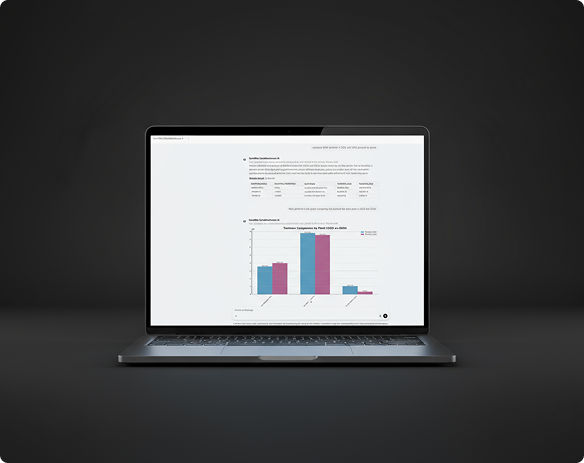
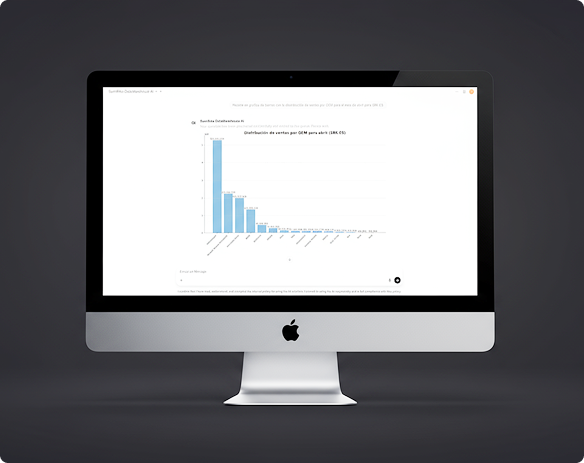
- Automatic generation of SQL and visualizations: Implementation of agents capable of translating natural language into valid SQL queries against SQL Server, automatically generating interactive graphs when the question requires visual representation.
- Fluid integration with Open WebUI for conversational experience: Development of customized pipelines that connect LangGraph with Open WebUI, implementing asynchronous processing using Redis queues to maintain the responsive interface during long-duration operations. Management of streaming responses, conversational state and rendering of graphs in chatbot format accessible to non-technical users.
- On-Premise security and control with hybrid scalability: Deployment of local LLM models ensuring confidentiality, with architecture prepared for Azure resource consumption without compromising data privacy.
Key Success Factors
Multi-agent orchestration with LangGraph
We use LangGraph to implement a directed graph architecture with reusable subgraphs, allowing complex decision flows and error handling with automatic retries. This modular architecture facilitates scalability and system maintenance.
Strategic selection of specialized LLMs
We combine different models according to the task: we use a model for routing and natural language responses, and another model for SQL code generation. This strategy optimizes computational costs and precision.
Intelligent context system based on YAML
We implement a pre-defined database schema metadata in YAML that avoids costly dynamic queries. Intelligent filtering of relevant tables reduces the context sent to the LLM, improving precision and reducing latency by 60%.
Asynchronous infrastructure with Redis and workers
We design a decoupled architecture using Redis queues that allows asynchronous processing of complex queries, maintaining the responsive interface (Open WebUI) while long-duration operations are executed in independent workers.
Automatic generation of visualizations with volume validation
The Graph Assistant includes decision logic (LLM-based) to determine whether to reuse existing data in conversation or execute new SQL queries, optimizing resources. Additionally, it validates the volume of data before rendering graphs, preventing memory errors.
Methodology

Iterative proof of concept

Design Thinking applied to agent architecture

Modular development with reusable subgraphs

Synthetic data testing and domain validation
Gradual deployment with monitoring
Iterative proof of concept
Design Thinking applied to agent architecture
Modular development with reusable subgraphs
Synthetic data testing and domain validation
Gradual deployment with monitoring
Results

- The developed solution allowed centralizing all critical business information and accessing it through a conversational assistant, significantly reducing the time required to obtain relevant insights. Thanks to the AI model, users without technical knowledge can query complex databases and receive complete analyses in seconds, replacing manual processes that previously required hours. Automation of document processing and immediate generation of graphs and summaries improved operational efficiency and accelerated decision-making.
- The platform, deployed in a secure On-Premise environment and with hybrid architecture, guarantees total control over sensitive data while allowing the computation to scale when necessary.